
![[Successful Case] Lawyer Abby Successfully Represented American Clients in Lawsuit Against Henan Supplier](https://abbylawyer.com/wp-content/themes/wangao/images/img46.png)
November 28, 2023
The most common inquiry we received during the pandemic was, “I purchased masks, mask machines, rubber gloves, etc. from China, but they have not been delivered. What should I do?” Many of our clients paid high deposits, but due to the delayed delivery by the supplier, they missed the golden period of medical product sales. When they sought refunds, the Chinese suppliers found excuses to delay refunds, leaving legal action as the only means of resolving the dispute.
Many clients are concerned that legal action takes too long and incurs high time and financial costs.
Today, using this case as an example, let’s take a look at how long it would take for a lawsuit to go from hiring a lawyer to receiving a refund and compensation from the other party.
The flowchart is as follows:
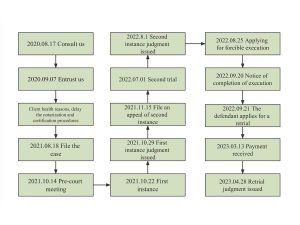
Usually, if the case can be resolved during the first stage, there is no need for an appeal. If either party is dissatisfied with the verdict in the first stage, they can appeal to a superior court. As for the enforcement stage, if the defendant voluntarily complies with the judgment, this step is not needed.
In China, there are only two procedures for litigation cases:
the first and second appeals. However, if either party believes that the second instance court’s verdict is incorrect, they can apply for a retrial by the second instance court [the third stage]. A retrial usually requires specific conditions to be met before it can be initiated, and the chance of success in obtaining a judge’s support to modify the judgment of the second instance is very small.
In this case, the second-instance judge examined the case very carefully. The second-instance judge verified one by one whether there was a legal basis for the content of the first-instance judgment. Regarding several points of dispute in this case, the judge required the plaintiff and defendant to respond one by one in court and asked them to provide corresponding evidence.
There is a litigation technique we used where we deliberately guided the judge to suspect that the defendant’s malicious behavior of failing to deliver the goods to evade debt was fraud and might involve criminal cases, which affected the reputation of Chinese enterprises. We suspected that the batch of goods purchased by our client may have never existed from beginning to end.
This successfully caught the attention of the judge. The judge began to ask the other party whether they had already completed the purchase from the factory and inquired about the details of the goods purchased by the other party, asking that they disclose the name of the factory for investigation.
Finally, one month after the trial, we received a judgment of winning the second appeal. Like the judges in the first appeal, the second-instance judges supported all our claims.
Note: Chinese judges typically do not announce the trial result immediately after the hearing or issue a judgment immediately. They usually hold an internal discussion after the hearing and then issue a written judgment. The judgment is typically issued within a few weeks or months after the hearing.
In summary, in China, a litigation case usually lasts three to six months for the first instance, six to nine months for the second appeal, and three to six months for applying for compulsory enforcement. A litigation case typically requires a lawyer to appear in court two to three times, so preparing a budget for the lawyer’s travel expenses is essential.
 Schedule A Free Consultation