
Recently, our firm’s attorney Abby Wang (Wang Ao) successfully represented a Philippine national in a cross-border divorce dispute. What made this case exceptional is that the client’s home country, the Philippines, is one of the few nations in the world that prohibits divorce in principle. Faced with this legal deadlock, Attorney Wang relied on deep professional expertise and flexible litigation strategy to open the door to freedom for her client through a Chinese court. This article reviews the key milestones of a foreign divorce in China and shares practical insights for fellow practitioners.
At the outset, the biggest obstacle was jurisdiction. The marriage was celebrated in the Philippines; the plaintiff was a Philippine national living abroad. Would a Chinese court even accept the case? In practice, many courts take a cautious stance toward cases where “the person is abroad and the marriage is abroad.” But we were confident that the law provided the key to breaking the deadlock.
Under Article 21 of the Civil Procedure Law, the general territorial jurisdiction principle of “the plaintiff follows the defendant” applies. As long as the defendant’s domicile or habitual residence is within the territory of the People’s Republic of China, the Chinese court has jurisdiction. In this case, the defendant (the husband) was a Chinese citizen who had long worked and lived in China. The Chinese court unquestionably had lawful jurisdiction.
Rather than retreating after the court’s initial reluctance, we prepared a detailed written jurisdictional memorandum. From multiple dimensions — legislative intent, judicial practice, and international norms — we systematically argued the propriety and reasonableness of the defendant’s domicile court exercising jurisdiction. The court ultimately adopted our position and docketed the case. This step was the foundation for everything that followed.
With jurisdiction resolved, the authenticity of evidence became the new roadblock. The Philippine marriage certificate and child’s birth certificate we submitted could not be found in the Philippine government’s newly updated online verification system because they had been issued years earlier.
Evidence is the cornerstone of litigation. If authenticity is not recognized, the entire case faces the risk of losing. We did not opt for a simple substitute; instead, we rose to the challenge and launched a dual-track verification mechanism of “official communication + embassy/consulate authentication.”
On one front, we repeatedly communicated with the relevant Philippine government department through international mail and ultimately obtained its official written reply, confirming that historical data could not be queried online due to a system upgrade — indirectly proving the authenticity of the evidence in question. On another front, we actively assisted the judge in verifying the authenticated official documents through the Embassy of the People’s Republic of China in the Philippines. Although this process was time-consuming and labor-intensive, it ultimately dispelled the tribunal’s doubts about the integrity of the evidence chain and cleared the way for establishing the core facts.
With procedural and evidentiary issues resolved, the case entered substantive trial. The core questions were how to prove to the court that “the relationship had irretrievably broken down” and how to secure the best interests of the child.
We constructed a multi-dimensional evidentiary system:
When this logically rigorous, well-supported complaint and evidence package were presented to the other side, they clearly foresaw the direction and outcome of the litigation. Ultimately, under the court’s auspices, the parties reached agreement on divorce, child custody, and property division, concluding the case successfully through mediation.
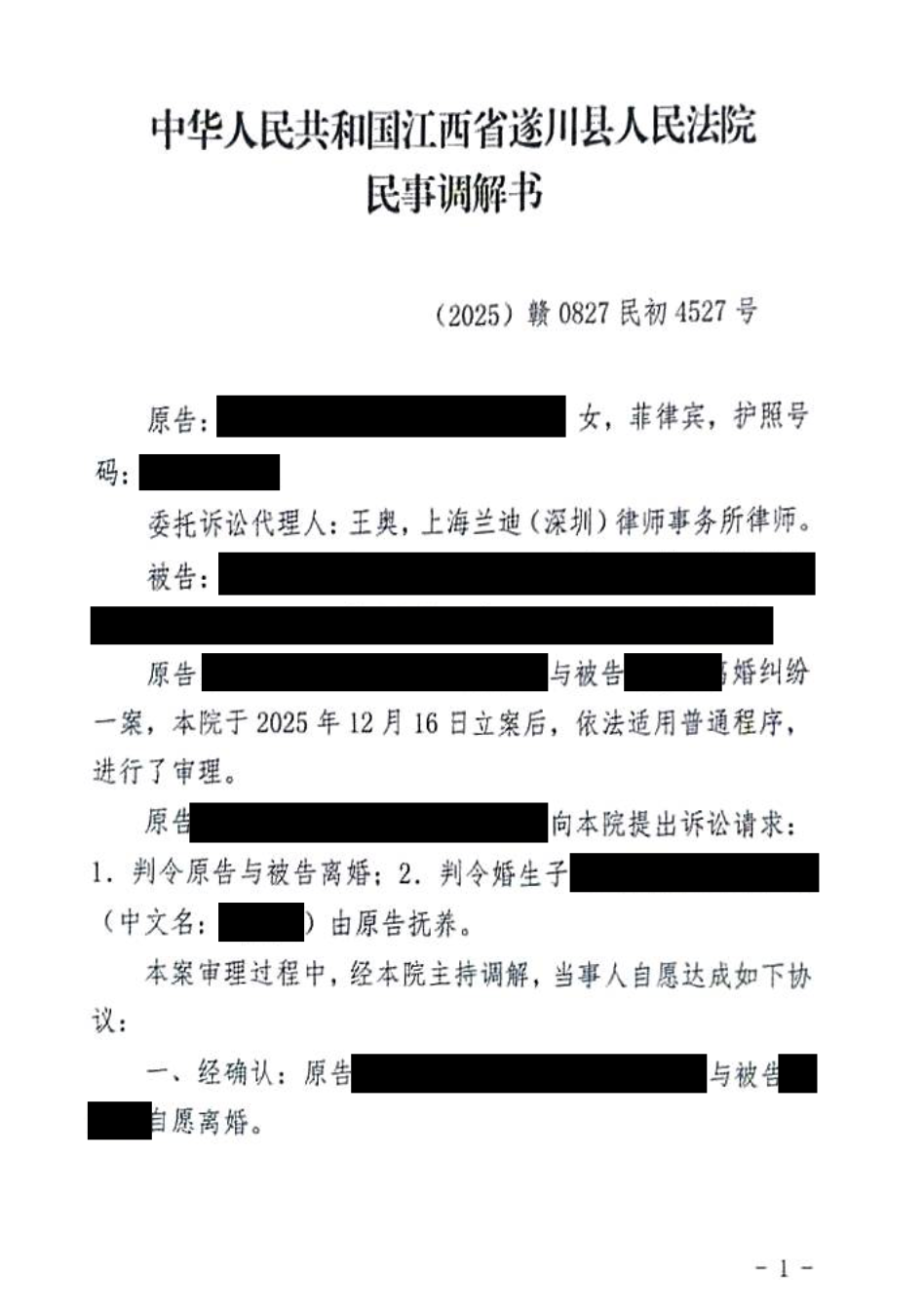
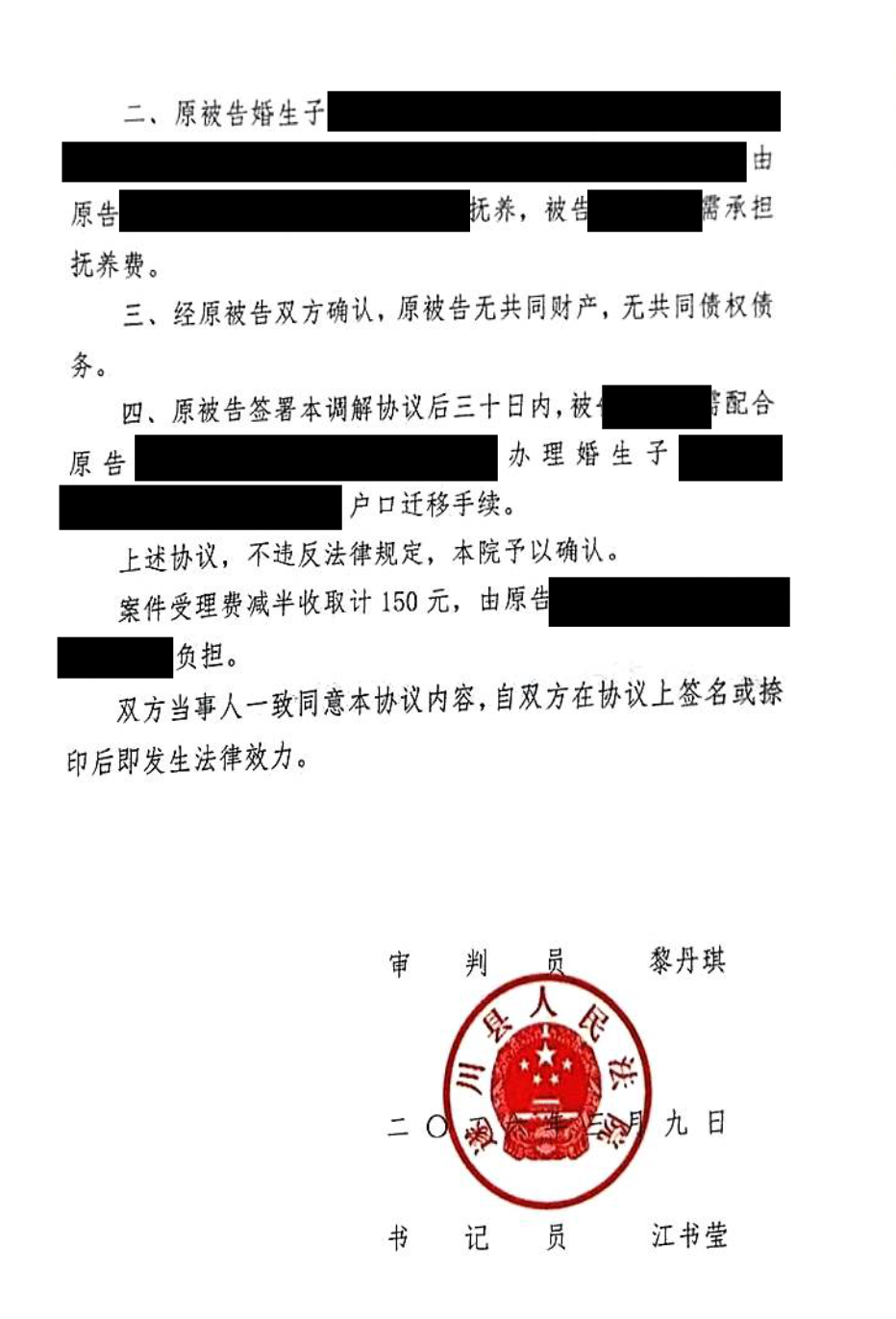
Handling this case was a comprehensive test of a lawyer’s professional ability. It required not only familiarity with domestic law but also an understanding of private international law and foreign legal systems; not only skill in courtroom advocacy but also the ability to coordinate with institutions in different countries.
More importantly, it reminded us that as lawyers we handle not merely cases, but the lives of our clients. Facing a client stranded abroad whom her home-country law could not relieve, we helped her find the correct remedy through professional legal judgment and secured her rightful interests through meticulous evidence organization. A foreign divorce in China is never just a procedural matter — it is a life reset.
The law may have borders, but the pursuit of justice should have no barriers. In the complex legal labyrinth, helping clients in distress find the exit toward the light is precisely the value of us as legal professionals.
(This article is compiled from a real case handled by Attorney Abby Wang. Client information has been desensitized.)
 Schedule A Free Consultation